
Idaho Early Literacy Project (IELP): Year One Student Growth Results

Lee Pesky Learning Center (LPLC) announces an important leadership transition. Executive Director Maureen O’Toole will be stepping away from her position to attend to family health matters. The entire LPLC community expresses deep gratitude for Maureen’s leadership, compassion, and unwavering dedication to advancing our mission of helping students, families, and educators overcome learning challenges and reach their full potential. 

During her tenure, Maureen guided the Center through a period of growth and adaptation while strengthening relationships with community partners, expanding access to services, and championing programs that ensure all learners have the tools and support they need to succeed. Her empathy, professionalism, and focus on mission-driven impact have left an enduring mark on the organization and those it serves. 

Stepping into the role of Executive Director is Dr. Lindy Crawford, who previously led Lee Pesky Learning Center and now returns with optimism and a renewed vision for impact. Dr. Crawford brings deep institutional knowledge, decades of educational leadership experience, and an unwavering commitment to the Center’s mission. Her familiarity with LPLC’s team, community, and the broader educational landscape in Idaho ensures continuity, stability, and momentum during this transition. 

“Lee Pesky Learning Center’s professional expertise is second to none and it is my great honor to once again serve alongside an incredibly accomplished and deeply empathetic team,” said Dr. Crawford. “For close to 30 years, LPLC has led educational innovation using an evidence-based approach to teaching and learning. I am excited to play a small part in our continued evolution.” 

Board Chair Jim Foudy added, “We are profoundly grateful to Maureen for her care, leadership, and commitment to every learner we serve. We’re equally confident in welcoming Lindy back to guide LPLC into its next chapter. Her deep knowledge of LPLC and her passion for education will be a great asset to the organization during this transition period.” 

For nearly three decades, Lee Pesky Learning Center has helped thousands of students, families, and educators overcome obstacles to learning through direct academic and clinical services, professional training, and community partnerships. The organization remains steadfast in its mission to ensure every learner has the opportunity to thrive. 

Lee Pesky Learning Center is proud to report that we have completed Year 1 of the IELP. We worked in seven Idaho school districts and # preschools: Caldwell, Kuna, Nampa, Jerome, Shelley, Mountain Home, and West Bonner. The project is focused on four goals:

1.   Train teachers from PreK – 2nd grade to implement evidence-based reading instruction.

2.   Provide coaching to teachers to build their capacity to deliver effective instruction.

3.   Improve early reading outcomes for students.

4.   Inform policy and systems change in Idaho.

Preschool Outcomes

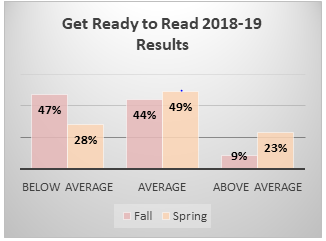
We trained 87 preschool educators working in a variety of childcare settings. To measure children’s early literacy skills, we used a short test called the Get Ready to Read! (GRTR) screening tool. You can read more about the GRTR here. The chart below shows an18 percentage point increase in the number of children at or above average from fall to spring. Scoring in this range by the end of preschool means they are on the path to kindergarten readiness.
Kindergarten Outcomes

We trained 97 Kindergarten teachers across the seven school districts. Kindergarten students are tested at least three times per year with the iStation, the early reading test adopted by our state. In fall, 32% of students were able to meet grade level targets. In spring, 57% of students met targets, for a 25 percentage point increase. The statewide average growth was 18%.  It is important to note that all of the participating schools are Title 1 schools, serving a majority of students from low income backgrounds. 

Conclusion

We have learned a great deal about what it takes to make a real and lasting difference for students. We continue to work with teachers and principals to understand the factors that lead to strong gains, including:

1.   Having a clear and common schoolwide focus on improving early reading outcomes.

2.   Using evidence-based instructional practices in the way in which they are intended to be used.

3.   Involving school leaders.

4.   Responding to data. When schools use data effectively, better results are achieved.

Changing the trajectory for students who are most at-risk for poor school outcomes is hard work, but it is work worth doing. It takes a strong system to make a difference – that system is comprised of teachers who are dedicated to realizing strong outcomes for students, principals who provide the support that teachers need, and reading experts, who can provide the training and coaching to help teachers thrive. When this system is guided by policy and funding mechanisms that signal a true commitment to positive outcomes for all students, we all win.


You May Also Like

Science of Reading

Science of Reading

The Lee Pesky Learning Center specializes in literacy instruction grounded in...